
The Only Music Theory Adult Cello Beginners Actually Need to Get Started
If one of your goals this year is to start learning the cello as an adult—or to return to the instrument after a long break—you may be wondering how much music theory you need before you begin.
For many adult beginners, music theory can feel intimidating, confusing, or like something that must be mastered before making any real progress on the cello. In this post, I’ll share the bare minimum music theory every adult cello beginner needs in order to get started confidently—without delaying the joy of actually making music.
I believe the most important thing at the beginning is to focus on pulling beautiful, satisfying sounds from your cello from day one. Creating a sound you enjoy is what is going to keep you excited and motivated to continue learning this great instrument.
Do Adult Cello Beginners Need to Learn Music Theory First?
Music theory is, without a doubt, a very important element of becoming a complete musician and a more informed listener — and as you might expect, the more advanced you become, the more essential music theory becomes so that it does not become a limiting factor on your progress.

For some adults -
feeling like you need to “learn the theory first” can become the very thing that delays or derails your progress.
But it does not need to be something you master before you ever pick up the instrument
In fact, for some adults, feeling like you need to “learn the theory first” can become the very thing that delays or derails your progress.
On the other hand, going in without any knowledge whatsoever can slow down certain aspects of learning the cello and make learning how to read music feel more daunting than necessary.
So here is a list of some of the most helpful and basic theory-related information to take with you as you get started.
1. The Names of the Open Cello Strings (A–D–G–C)
This is essential right from the beginning.
If you are seated at the cello and looking down at your fingerboard, from left to right the strings are:
A – D – G – C
The A string is the highest-pitched (and thinnest) string and sits on the far left. Each successive string is pitched a perfect fifth lower, until you reach the C string, which is the lowest and thickest.
Why does this matter?
First, it gives you a sense of orientation on the instrument. You’re no longer guessing where you are — you have the beginnings of a mental map. Second, teachers and method books often talk in a sort of shorthand. You might hear something like:
“F♯? Oh, that’s third finger on the D string.”
If you know your strings by name, that sentence makes sense. If you don’t, it can feel confusing very quickly.
If you enjoy mnemonic devices, you can remember the strings from highest to lowest as:
All Dogs Go Crazy (A–D–G–C).
In my experience, adults are more likely than children to want a clear sense of the big picture when learning something new. Knowing your string names — and the direction pitch moves from highest to lowest — is an essential first step.
Bonus tip:
If you’re mapping the notes on the cello's fingerboard (in 1st position only) to written music in bass clef, it can help to imagine the strings as horizontal lines:
Open A = top line of the staff
Open D = middle line
Open G = bottom line
Open C = two ledger lines below the staff
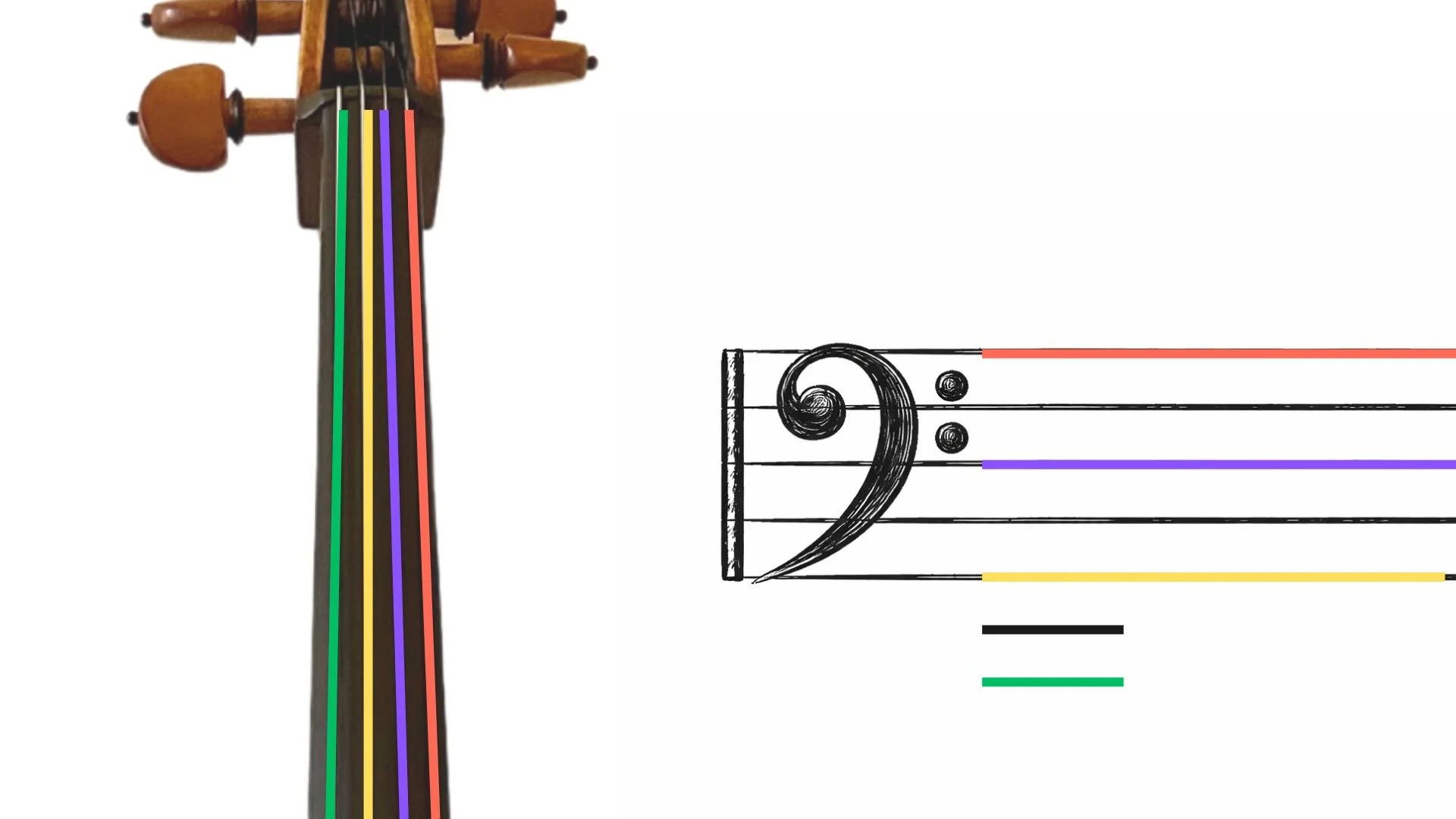
From this perspective, for example, any notes in 1st position on or above the top line would be played on the A string.
2. On the Fingerboard, Higher in Pitch Means Lower to the Ground
Obviously, when we hear the word higher, we tend to think “up.” But because of how the cello is held, moving higher in pitch means your fingers need to move toward the bridge — closer to the ground.
Likewise, when you’re told to go lower in pitch, your fingers need to move back toward the pegbox — away from the ground.
This discrepancy honestly tends to feel normal pretty quickly, but mentioning it here will hopefully help you avoid feeling disoriented in those first lessons and practice sessions when it's so important to build excitement and momentum.
Bonus tip:
Speaking of intonation, I fully endorse the use of fingerboard tapes for adult beginners.
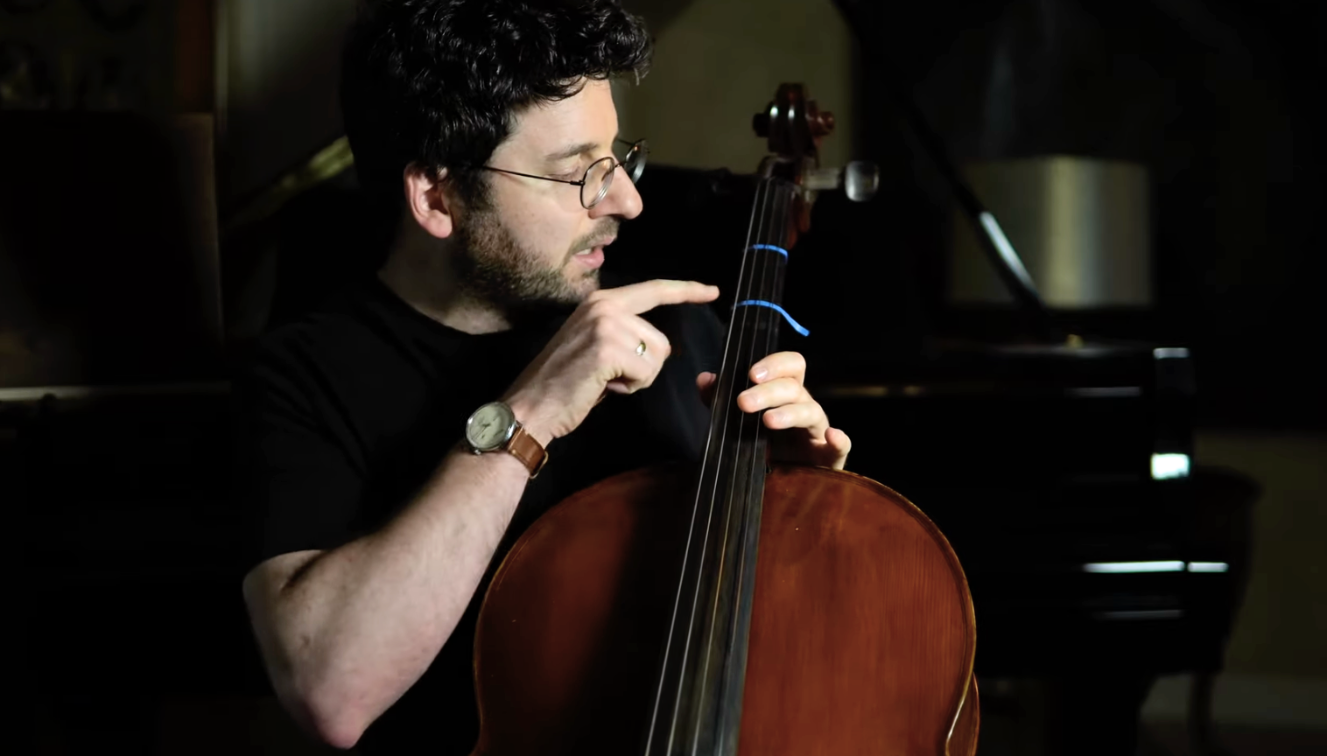
By refusing tapes -
You are asking an untrained ear to verify whether your finger is in the right place or not.
Unless you already have a well-trained musical ear, refusing tapes simply on principle is often counterproductive because you are asking an untrained ear to verify whether your finger is in the right place or not.
I also think that tapes can truly help to speed up the pure muscle memory needed to create and remember the left hand frame in 1st position (essentially the distance between the 1st and 4th fingers).
If you use fingerboard tapes as a tool to be discarded sooner rather than later, they can dramatically reduce frustration in the early stages.
Click here to view my foolproof step-by-step method for taping your cello fingerboard.
3. Feel Rhythms Instead of (Over)Thinking Them
If reading music and processing rhythms are both new for you, it can feel overwhelming to do the latter while also figuring out note names, fingerings, and bowings in real time.
When it comes to rhythm, I've found that it becomes far less challenging when it’s felt, not merely analyzed.
Adult learners have a tendency to be a bit cerebral when it comes to rhythms. For example, instead of silently analyzing the rhythm in a new piece, try incorporating your body (including your voice) to help internalize the rhythm physically. A layered approach to do so could look like the following 3 steps:
1) Count the rhythm out loud (instead of silently)
2) Add clapping to the pulse of the music while verbalizing the rhythm
3) Move your body (dancing, marching, swaying, etc) to the pulse of the music while clapping and verbalizing the rhythm

You don't have to go full musical theater mode -
Simply swaying back in forth in your chair to the pulse of the music will help you to feel the rhythm instead.
You don't have to go full musical theater mode for this to be effective. Simply swaying back in forth in your chair to the pulse of the music will help you to feel the rhythm instead of trying to simply count steadily with your mind alone.
The more you can physically internalize the pulse and rhythm of the passage you are working, the more that rhythm will feel and sound more natural rather than mechanical.
Just as your body predicts the upcoming beats when dancing to a pop song, your sense of rhythm will become steadier and more reliable the more you internalize the pulse of the music you are playing.
4. What Scales Are
Many adults who are rank beginners (like I was when I started at age 25) can feel a quiet embarrassment around scales — we've heard the term thrown around countless times and so it feels a bit uncomfortable having to admit that we don't really understand what that musical term truly means.
Simply put:
A scale is a series of notes that starts on a home pitch (the tonic) and ends on that same pitch an octave higher or lower.
For example:
C major: C–D–E–F–G–A–B–C
The two most common scales you’ll encounter early on are:
Major (often described as happy-sounding)
Minor (often described as sad-sounding)
There are many other types of scales (including modal, chromatic, pentatonic, octatonic, and multiple types of minor scales), but at the beginning, this basic understanding is enough to get you started.
For the overwhelming majority of the music you'll encounter, especially early on in your cello journey, scales will serve as the building blocks from which musical melodies and harmonies are constructed. This is one reason why practicing scales can be such a valuable activity.
5. What Intervals Are and Why They Matter on the Cello
Like scales, intervals are foundational to understanding the way music works, in this case the way in which notes relate to one another. This was another term I personally had heard many times only to realize that I had no working definition until I was in the middle of a cello lesson sheepishly looking for further clarification.
Simply put:
An interval is the distance between any two notes.
An interval can describe:
The distance between two different notes
Or even the distance between two notes that are the exact same pitch, which is called a unison (hence the term "singing in unison," which means two or more people singing the exact same pitches together).
Eventually, learning to recognize intervals by ear — and even sing them — will be tremendously valuable. But at the beginning, the most important thing is simply understanding what the word means when you hear it.
Knowing what intervals are allows you to understand how musicians, teachers, and students talk about notes in relation to one another, rather than as isolated sounds.
Below is a complete list of the intervals that occur within the span of one octave, starting on C natural:
C to C - unison (same pitch)
C to D♭ — minor second
C to D — major second
C to E♭ — minor third
C to E — major third
C to F — perfect fourth
C to F♯ — tritone
C to G — perfect fifth
C to A♭ — minor sixth
C to A — major sixth
C to B♭ — minor seventh
C to B — major seventh
C to C — octave
Just to be clear, this is not a list to memorize asap; however, I do think it is helpful to have these intervals arranged in a clear list so that you can understand, for example, that someone is describing an interval when the say "the melody then makes a leap of a major sixth..."
That being said, understanding intervals thoroughly will definitely help you fast track your progress on the cello (especially when it comes to fingerboard geography) and as a musician.
If you do want to train your ear to distinguish intervals aurally sooner rather than later (which I highly recommend), there are wonderful online tools that offer simple interval quizzes and listening exercises. But even without doing that work yet, just knowing what an interval is already gives you some understanding to the vocabulary musicians (and teachers) will use to describe the relationship between notes (both on the fingerboard and on the written page).
If you’re planning to begin your cello journey this year or are returning to it after a long pause, my hope is that this list will help ease the learning process so that you can truly focus on pulling gorgeous ribbons of sound out of your instrument.





The right instrument can make learning the cello much easier and thus much more enjoyable.